
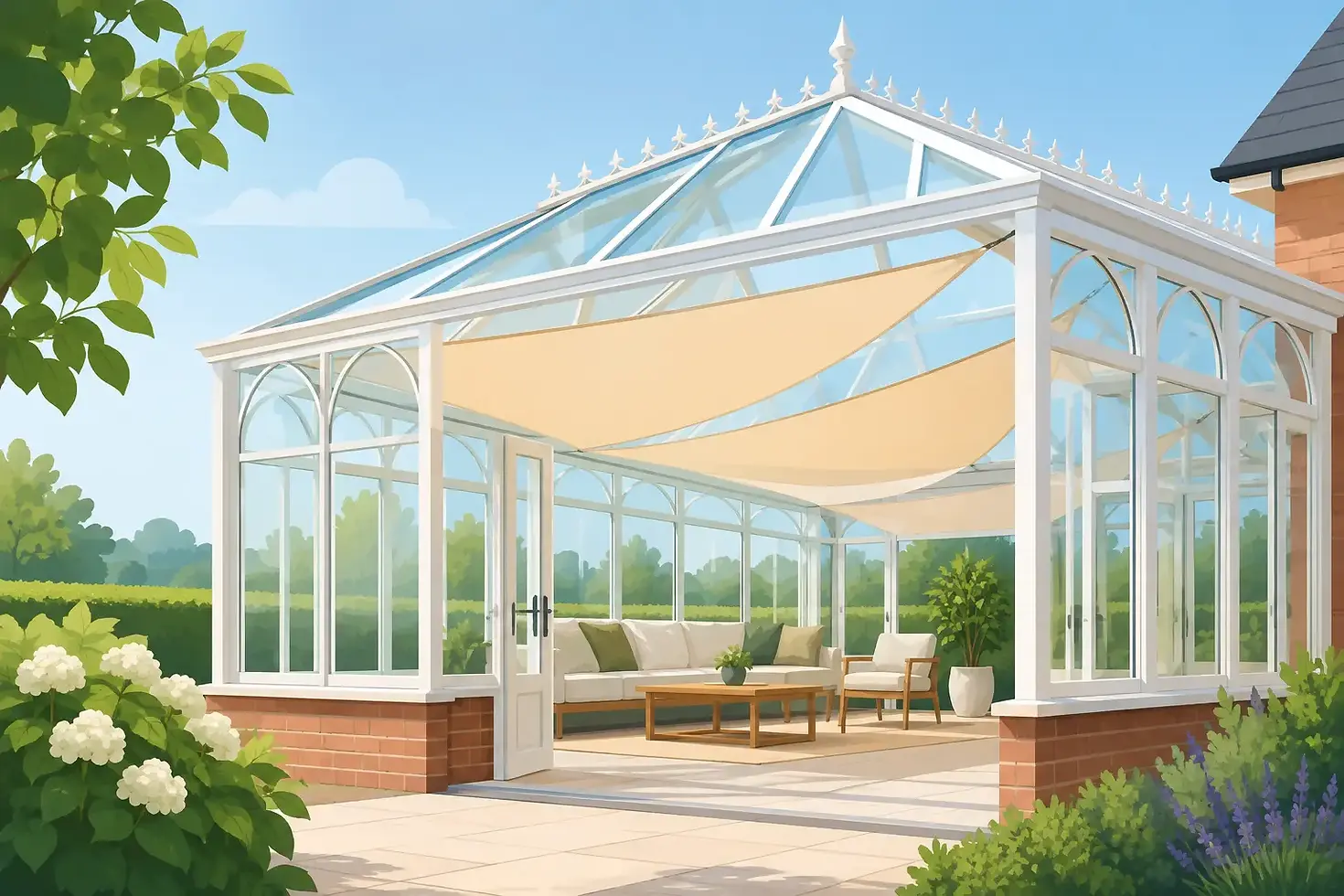
Shade Sails in Victorian-Shaped Conservatory Images

A Victorian conservatory can look beautiful in a photograph and still be difficult to use on a bright afternoon. Its faceted roof, decorative ridge and multiple glazing panels create character, but they also let in intense sun from several angles. When looking at shade sails in Victorian-shaped conservatory images, the most useful detail is not simply the fabric colour. It is how the sails follow the roof layout while leaving the room feeling light, open and properly finished.
Bespoke conservatory sail blinds are designed for exactly this type of space. Instead of covering every pane with a separate blind, shaped fabric sails are fitted beneath the roof glazing to soften glare, reflect heat and give the conservatory a calmer appearance. The result is practical shading that suits the architecture rather than competing with it.
What Victorian-shaped conservatory images can tell you
A Victorian conservatory normally has a rectangular front with an angled or bay-shaped face. The roof often includes a central ridge, several sloping sections and a mixture of narrow and wide panels. This means a standard, off-the-shelf blind is rarely a convincing answer.
Good images of shade sails show how each section has been measured and planned around the roof structure. You may see triangular sails meeting along the ridge, longer sails running through the main roof sections, or carefully spaced panels that echo the lines of the frame. These details matter because the shape of the sail affects both performance and appearance.
Look for a layout that leaves a small, consistent gap around the framework rather than fabric that appears stretched awkwardly from one side to the other. The sail should look intentional, with clean edges and balanced sections. In a Victorian conservatory, symmetry often works particularly well, although an asymmetric layout can be the better choice where one side receives the strongest afternoon sun.
Images are useful for narrowing down the look you prefer, but they cannot show every practical requirement. The direction your conservatory faces, the height of the roof, nearby trees and whether the room is used for dining, working or relaxing will all influence the best design.
Why sails work so well beneath a Victorian roof
Traditional conservatory blinds can involve a large number of individual units. On a roof with many facets, that can mean more visible hardware, more cords or controls, and a higher overall cost. Sail blinds offer a simpler visual alternative while still addressing the main problems caused by glazed roofs.
High-quality conservatory sail fabric can reflect up to 70% of solar heat, helping to reduce the build-up that makes a conservatory unpleasant during warmer weather. It also cuts harsh glare, which is useful around television screens, laptops and dining tables. The room remains naturally bright, but the sharpest light is filtered before it reaches the living space.
The soft, tensioned appearance of sails also suits Victorian conservatories particularly well. They break up a busy roof structure without hiding its shape completely. White, cream and light neutral fabrics tend to keep the room airy, while grey or warmer tones can bring more definition to a contemporary interior.
There is a trade-off to consider. Sails are fitted to provide effective overhead shading, but they are not intended to offer the pane-by-pane adjustment of some pleated blind systems. If you want to control each roof section independently throughout the day, another conservatory blind option may be more suitable. If your priority is a clean look, strong heat reduction and good value, sails are often the more practical choice.
Choosing a sail layout for your conservatory
The best arrangement begins with the roof, not a photograph. A front-facing Victorian conservatory with three or five facets may suit matching triangular sails across the bay, combined with larger central sections. A larger room can benefit from multiple sails arranged in a repeating pattern, creating a tailored finish and helping the fabric sit neatly across broad areas of glass.
The central ridge deserves close attention. In well-planned installations, the sails complement this line rather than obscuring it. They may meet close to the ridge or be positioned with a measured gap that keeps the design light. On roofs with vents, opening windows or roof-mounted fittings, the pattern should also allow access and avoid obstructing moving parts.
Fabric tension is equally important. A sail should sit smooth and secure, with enough tension to retain its shape without putting unnecessary strain on fittings. This is one reason professional measuring is worthwhile. Victorian roofs are rarely as straightforward as they appear from ground level, and small differences in angles can affect the finished result.
Colour, light and the view from inside
Most customers first consider how the sails will look from outside. That matters, but the view from your favourite chair matters more. Pale fabrics reflect light gently and can make a compact conservatory feel larger. They are a popular choice for traditional homes and rooms with white, oak or neutral furnishings.
Darker shades may provide a stronger design contrast and can feel more modern, particularly against anthracite frames. However, dark fabric can make a low roof feel more enclosed. It depends on the room, the amount of glazing and how much direct sunlight it receives.
When comparing conservatory shade sail images, also notice the wall and frame colours around them. A fabric that looks crisp against white uPVC can read very differently beside timber, aluminium or coloured frames. Taking a moment to consider samples in your own conservatory avoids choosing a colour based solely on a screen image.
Practical benefits beyond summer shading
The best conservatory shading should earn its place for more than a few hot weeks. Sails reduce eye strain from direct sunshine and make the room easier to use at different times of day. They can help protect furniture, flooring and soft furnishings from excessive fading too.
Maintenance is refreshingly straightforward. Conservatory sail blinds are designed to be easy to clean, and they can be seasonally removed if preferred. This is a real benefit in a room with high glazing, where dust and condensation can make complicated blind systems harder to maintain.
For homeowners improving a property before sale or letting, sails can also update a dated conservatory without the cost and disruption of replacing the roof. For commercial settings such as cafés, offices or showrooms with glazed extensions, they provide a neat, professional way to make bright spaces more comfortable for staff and visitors.
Why measuring and fitting make the difference
Photos can provide inspiration, but a made-to-measure survey turns the idea into a solution that works in your home. Accurate measuring accounts for every facet, ridge angle, frame position and potential obstruction. It also allows the installer to recommend where sails will have the greatest effect, rather than simply covering glass for the sake of it.
At Blinds and Sails, conservatory sail blinds are UK made to suit the individual roof and fitted professionally. Free measuring and fitting remove much of the uncertainty, while the express 48-hour service can be especially useful when a conservatory needs attention before a family gathering, a house move or the return of warmer weather.
Price should be considered alongside performance. The cheapest ready-made option can look tempting, but it may not fit the unusual geometry of a Victorian roof or deliver the neat finish shown in the images that first caught your eye. A bespoke sail system is often a lower-cost alternative to fully blind-covered roof designs, without compromising on the comfort that makes the room worthwhile.
From inspiration image to a usable room
Use images to identify the qualities you want: a bright neutral finish, a more contemporary grey scheme, a symmetrical pattern or maximum shading over the seating area. Then let the actual roof shape and the way you use the room decide the final arrangement.
A Victorian conservatory does not need to become a greenhouse in summer or a space you avoid when the sun is out. The right shade sails keep its distinctive character visible while making it a room you can enjoy far more often.


Comments